
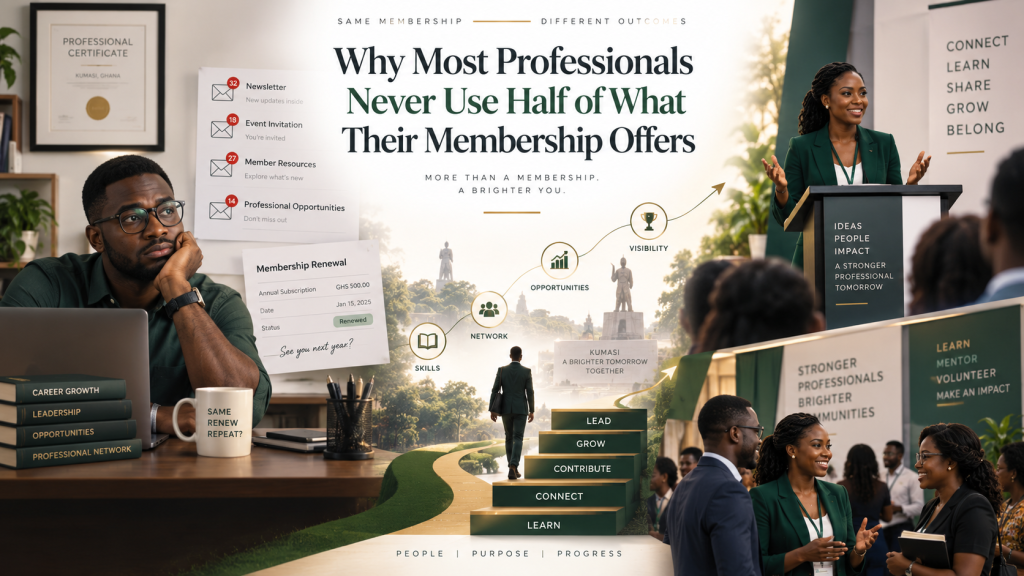
Kwame keeps his ICAG certificate in a nice frame in his sitting room in Kumasi. His mother is proud of it. His neighbours ask about it when they visit. Every year, without fail, he pays his subscription on time. He has never missed a renewal in twelve years.
And yet, if you asked Kwame what his membership has actually done for his career, he would struggle to give you a real answer. He has never attended a chapter meeting. He does not know who sits on the council. He gets the newsletter by email and deletes it, usually without opening it. He is, in every practical sense, a professional in name only within a body built to make him more than that.
He is not lazy. He is not unambitious. He is simply busy, the way most professionals in Accra, Kumasi, Takoradi, and Tema are busy, juggling client deadlines, family obligations, and the general exhaustion of daily life in a fast-moving economy. Nobody ever sat him down and explained what his membership was actually for, beyond the certificate and the discipline that comes with it.
Kwame is not unusual. He is, in fact, the norm.
The Certificate Is Only the Beginning
Ask most members of a professional body in Ghana, whether it is the Institute of Chartered Accountants, the Ghana Institution of Engineers, the Chartered Institute of Marketing Ghana, or the Ghana Bar Association, what their membership offers, and you will hear roughly the same two things every time. A recognised qualification. A code of conduct they are expected to follow.
Both are true. Neither is the full picture.
Behind those two things sits a much bigger offering that most members never touch: continuing professional development built specifically for their field, a community of peers who understand the exact pressures of their work, mentoring relationships waiting to be started, committees short of willing volunteers, and a genuine platform for building the kind of reputation that outlasts any single employer.
Most members pay for all of this every year and use almost none of it.
Meet Efua
Now picture Efua. She joined the same professional body as Kwame, around the same time, with a similar CV and similar ambitions. Today, people at industry events in Accra know her by name. She sits on a technical committee. She has spoken at two conferences this year, one in Accra and one in Cape Coast. When a board position opened up recently at a mid-sized firm, three people recommended her before she even applied.
Efua did not do anything extraordinary to get here. She simply treated her membership differently from day one. She joined her local chapter’s WhatsApp group and actually read the messages. She said yes the first time someone asked her to help organise a small event. She showed up to a few gatherings even when she did not know anyone in the room yet. None of it felt like a big decision at the time. Looked at together, over several years, it built an entirely different career from the one Kwame is quietly living.
The difference between them was never talent. It was a handful of small, repeatable choices, made early and kept up over time.
Why the Gap Exists
If active membership pays off this clearly, why do so many professionals still end up like Kwame rather than Efua?
Mostly because nobody ever hands new members a map. The welcome pack tells you what you owe and what rules you must follow. It rarely tells you, in plain terms, what to actually do with the relationship once you have joined. So most members default to the version that requires the least effort: pay, renew, comply, and otherwise forget the whole thing exists until the next invoice arrives.
There is also a quieter reason, one that is harder to admit. Many professionals assume that active involvement is for people who are already senior, already confident, already “there.” They tell themselves they will start volunteering once they have more experience, once they feel more established, once things are a little less busy at work. That moment, for most people, never actually arrives on its own. It has to be chosen, deliberately, usually well before it feels comfortable.
What Getting Started Actually Looks Like
None of this requires a dramatic reinvention. It rarely does.
It might mean attending one chapter meeting this quarter instead of skipping it again. It might mean finally reading your professional body’s code of conduct properly, instead of assuming you already know what it says. It might mean saying yes the next time someone asks for a volunteer for something small, a student mentoring session, a newsletter article, help at a registration desk during a conference.
These are not impressive achievements on their own. But they compound. The member who shows up consistently for three years tends to end up somewhere very different from the one who never shows up at all, even though both of them paid exactly the same fees.
The Real Question Worth Asking
The next time your subscription renewal lands in your inbox, it is worth pausing on one honest question before you pay it without thinking: are you actually using this membership, or are you simply holding onto it?
Both cost the same. Only one of them builds anything.
This post draws on ideas from Maximising Your Professional Membership, available now at www.asarebediakoadams.com