

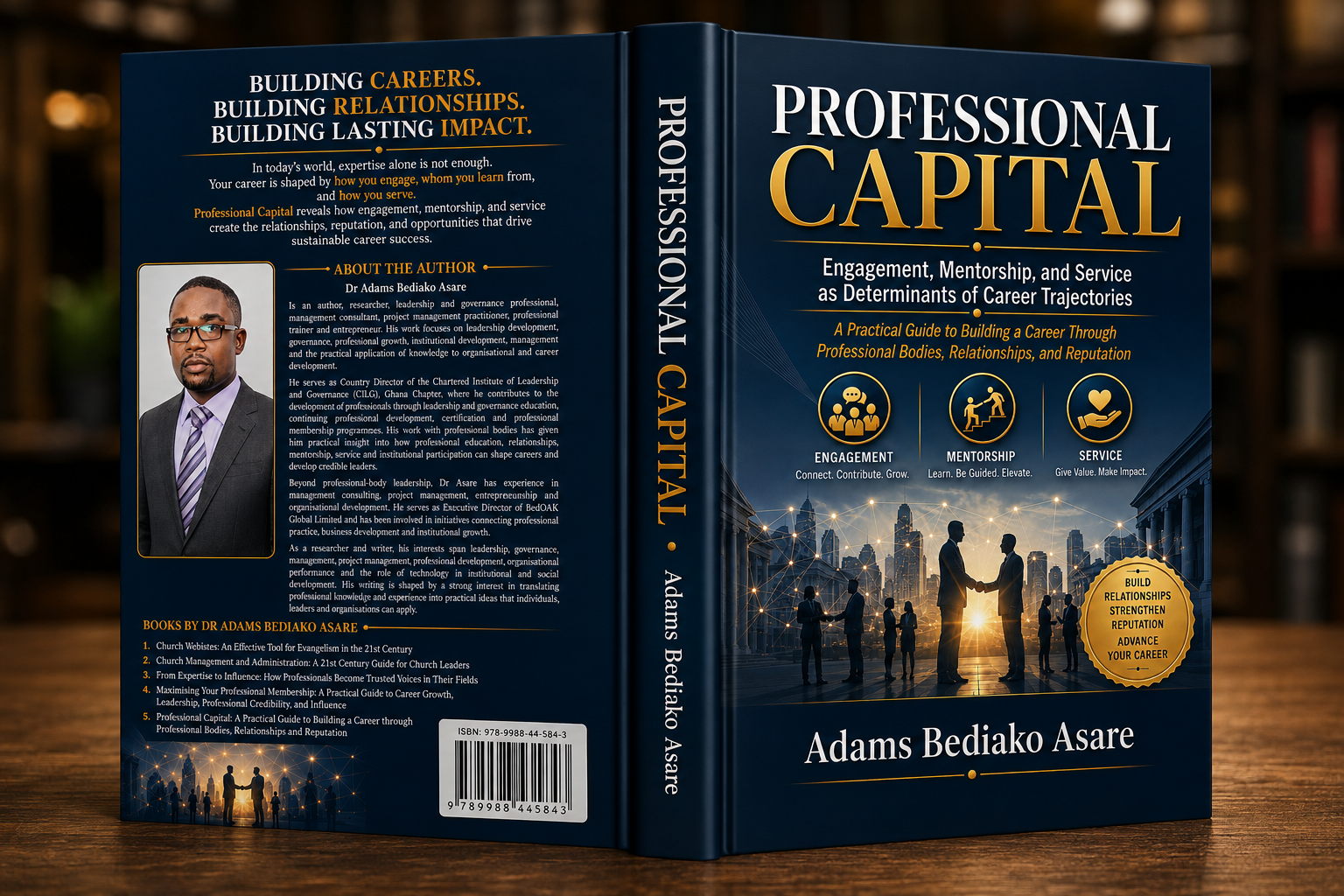
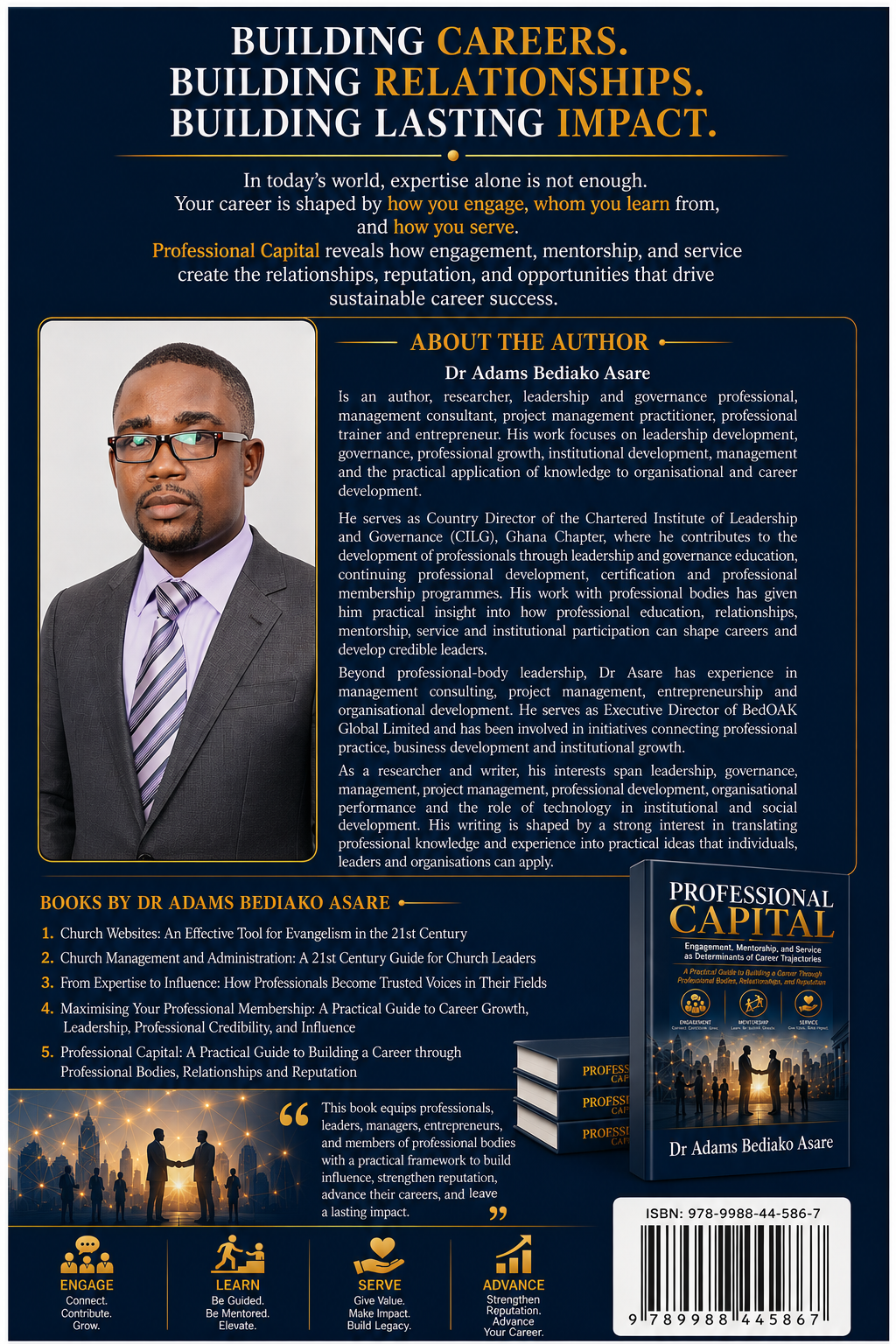

PROFESSIONAL CAPITAL
Engagement, Mentorship, and Service as Determinants of Career Trajectories
By Dr Adams Bediako Asare
You may have the qualifications. You may have years of experience. You may be highly competent at what you do.
But is competence alone enough to move your career forward?
Professional Capital: Engagement, Mentorship, and Service as Determinants of Career Trajectories examines one of the most important but often overlooked realities of professional development: careers do not advance through qualifications and technical competence alone.
Professional progress also depends on the relationships you build, the professional communities in which you participate, the people who trust your judgement, the mentors and sponsors who guide and advocate for you, the service you give to your profession and the reputation you develop over time.
Dr Adams Bediako Asare describes the accumulated value of these relationships, contributions and professional experiences as Professional Capital.
Professional capital is built through participation, not possession. Holding a membership certificate may establish your affiliation with a professional body, but meaningful career value develops when you engage, contribute, serve, mentor, learn, build trusted relationships and become recognised for responsible professional conduct.
Why Qualifications Alone May Not Be Enough
Education, professional certifications, technical competence and experience remain important foundations of a successful career. But professionals with similar qualifications often experience very different career outcomes.
Why does one professional gain access to leadership opportunities, board appointments, advisory positions and influential networks while another equally qualified professional struggles to progress?
Why do some professionals become trusted and recognised across their profession while others remain known mainly within their immediate workplace?
This book examines those questions through the concept of professional capital.
It explains how modern careers increasingly operate across organisations, institutions, professional bodies and networks. As careers become less dependent on a single employer, your professional reputation, relationships, service record and standing within the wider professional community can become significant career assets.
What Is Professional Capital?
Professional capital is the accumulated value you develop through active engagement within your profession.
It grows through:
- Professional engagement and participation.
- Mentorship and sponsorship.
- Service and volunteering.
- Trusted professional networks.
- Reputation and credibility.
- Governance and leadership experience.
- Knowledge sharing and professional contribution.
- Ethical conduct and professional responsibility.
- Long-term relationships within professional institutions.
Unlike technical competence, which primarily reflects what you know and can do, professional capital reflects how your competence connects with relationships, trust, contribution, recognition and institutional participation.
The book does not present professional capital as a replacement for competence.
Professional capital amplifies competence.
From Passive Membership to Active Professional Engagement
One of the book’s central arguments is that simply belonging to a professional body creates limited career value if membership remains passive.
Paying annual dues, collecting certificates, using post-nominal letters or occasionally attending events may establish membership, but these activities alone do not necessarily build strong professional capital.
Meaningful engagement requires sustained and contributory participation.
The book examines how involvement in committees, conferences, professional training, governance structures, publications, mentoring programmes, working groups and other professional activities can build visibility, trust and leadership readiness.
It also makes an important distinction between attendance and engagement.
Attendance means being present.
Engagement means contributing.
When you participate consistently, accept responsibility and contribute constructively, other professionals have an opportunity to observe your reliability, judgement, competence and professional conduct.
Over time, this can build trust.
And trust can create opportunity.
Mentorship as Social and Career Capital
Mentorship receives detailed attention throughout the book because professional careers rarely develop in isolation.
A good mentor does far more than give occasional advice.
Mentors can help you interpret professional expectations, understand unwritten norms, assess your readiness for opportunities, avoid costly mistakes and develop better professional judgement.
The book examines formal and informal mentorship, sponsorship, advocacy, reverse mentoring and intergenerational learning.
It also considers mentorship from the perspective of the mentor.
As your career develops, mentorship gradually changes from something you receive into something you provide. Supporting emerging professionals, transferring knowledge and preparing future leaders become part of professional responsibility and legacy.
Service as a Career Investment
Professional service is often treated as voluntary work with little connection to career development.
This book challenges that assumption.
Committee work, peer review, professional governance, mentoring, programme coordination and other forms of service can provide opportunities to demonstrate responsibility outside your normal employment.
Through service, you can develop and demonstrate:
- Leadership capability.
- Ethical judgement.
- Reliability.
- Governance experience.
- Collaborative decision-making.
- Professional commitment.
- Institutional knowledge.
- Accountability.
Sustained service can also strengthen your reputation and provide credible evidence of leadership readiness.
The book therefore encourages professionals to treat service strategically, while maintaining reasonable boundaries between professional involvement, employment and personal responsibilities.
Networks, Reputation and Professional Influence
Professional networks are not simply collections of contacts.
Effective networks carry information, opportunity, knowledge, trust and professional endorsement.
Professional Capital explains how networks develop through repeated professional interaction and how reputation grows from the way you contribute, communicate, serve and behave over time.
The book examines the relationship between networks, reputation, influence and stewardship.
Networks can create access.
Reputation can build trust.
Influence can shape decisions.
Stewardship can help preserve institutions and develop the next generation.
This progression helps explain why professional relationships should be built around contribution and trust rather than transactional networking.
Professional Bodies as Career Institutions
A major theme of the book is the role of professional bodies in career development.
Professional institutes and associations are often viewed mainly as organisations that issue certificates, collect membership dues and organise events.
Dr Asare presents a broader perspective.
Professional bodies can function as career institutions because they establish standards, regulate professional conduct, facilitate continuing professional development, provide mentoring opportunities, create leadership platforms, recognise professional contribution and connect members across organisations and sectors.
Their councils, boards, committees and working groups can also provide professionals with practical exposure to governance, accountability, collective decision-making and institutional leadership.
For professionals who engage strategically, these institutions can become important platforms for building professional capital.
Professional Capital Across Your Career
The value and form of professional capital change as your career develops.
Early Career
The focus is on learning, professional identity, mentorship, understanding professional norms and building a foundation for future credibility.
Mid-Career
The focus increasingly moves towards meaningful contribution, leadership positioning, governance exposure, reputation, service and stronger professional networks.
Senior Career
Professional capital increasingly becomes a matter of stewardship. Senior professionals can use their experience and influence to mentor others, preserve standards, support leadership renewal and strengthen institutions.
The book therefore encourages you to align your professional engagement with your career stage rather than pursue every available opportunity.
Professional Capital During Career Change
Professional capital becomes particularly valuable during periods of career disruption.
Job changes, organisational restructuring, career breaks, relocation, technological change and movement between sectors can weaken career stability.
During these periods, professional relationships, mentors, institutional affiliations and reputation can provide continuity beyond a single employer.
The book examines how professional capital can support career transitions, professional re-entry, sector changes and long-term career resilience.
It presents professional capital as a form of career insurance: something that may not prevent disruption, but can reduce its impact and support recovery when career circumstances change.
Professional Capital in the Digital Era
Professional relationships increasingly operate through digital platforms and virtual communities.
The book considers how digital participation can expand access to professional networks, online mentoring, knowledge exchange and professional visibility.
But it also addresses the risks of superficial digital engagement.
Professional capital cannot be measured simply by followers, connections or online activity. Digital visibility has value when it reflects genuine competence, responsible contribution and credible professional relationships.
Leadership, Governance and Professional Responsibility
As professional capital grows, so does responsibility.
Leadership roles within professional bodies, committees and governance structures can expose professionals to collective decision-making, accountability, ethical questions and institutional responsibility.
The book examines professional capital as a pathway towards leadership readiness and governance experience.
It also stresses that influence must be exercised ethically.
Professional capital built over many years can be damaged quickly through poor judgement, self-serving behaviour or ethical failure.
Credibility therefore remains one of its most important foundations.
Who Should Read This Book?
Professional Capital is written for:
- Students and early-career professionals building their professional foundations.
- Professionals who belong to institutes and associations but remain largely inactive.
- Mid-career professionals experiencing career stagnation or limited visibility.
- Professionals seeking leadership, governance or advisory opportunities.
- Senior professionals considering mentorship, stewardship and professional legacy.
- Academics and researchers seeking stronger professional engagement.
- Consultants and advisers building trusted professional networks.
- Executives and managers seeking wider professional recognition.
- Members and leaders of professional associations.
- Committee, council and board members.
- Professionals seeking stronger mentorship and sponsorship relationships.
- Professionals changing organisations, sectors or career directions.
- Professional bodies seeking to improve member engagement, mentorship and leadership development.
Build Your Own Professional Capital Strategy
The book moves from explanation to practical career strategy.
It encourages you to assess the strength of your current professional engagement, relationships, mentorship, service, reputation and institutional involvement.
From that assessment, you can make deliberate choices about where to participate, whom to learn from, how to contribute, which responsibilities to accept and how to position yourself for long-term professional relevance.
The objective is not to attend every event, join every committee or collect professional titles.
The objective is strategic participation.
You invest your time and professional contribution where they can develop your competence, relationships, reputation, leadership capability and value to your profession.
From Membership to Professional Stewardship
At its deepest level, Professional Capital asks you to reconsider what it means to belong to a profession.
Professional membership should eventually move beyond what you can receive from an institution.
As your career develops, the question changes.
It becomes:
What are you contributing to the profession that helped develop you?
Professional maturity is reflected in your willingness to mentor others, support professional standards, contribute knowledge, serve institutions, prepare future leaders and use your influence responsibly.
The progression therefore moves from membership to engagement, from engagement to contribution, from contribution to leadership and from leadership to stewardship.
Professional Capital provides a practical framework for professionals who want to build careers that extend beyond qualifications, job titles and individual achievement.
Because qualifications may open the door.
But relationships create access. Service builds credibility. Mentorship develops judgement. Reputation creates trust. And professional capital helps turn competence into lasting career value.

Reviews
There are no reviews yet.