
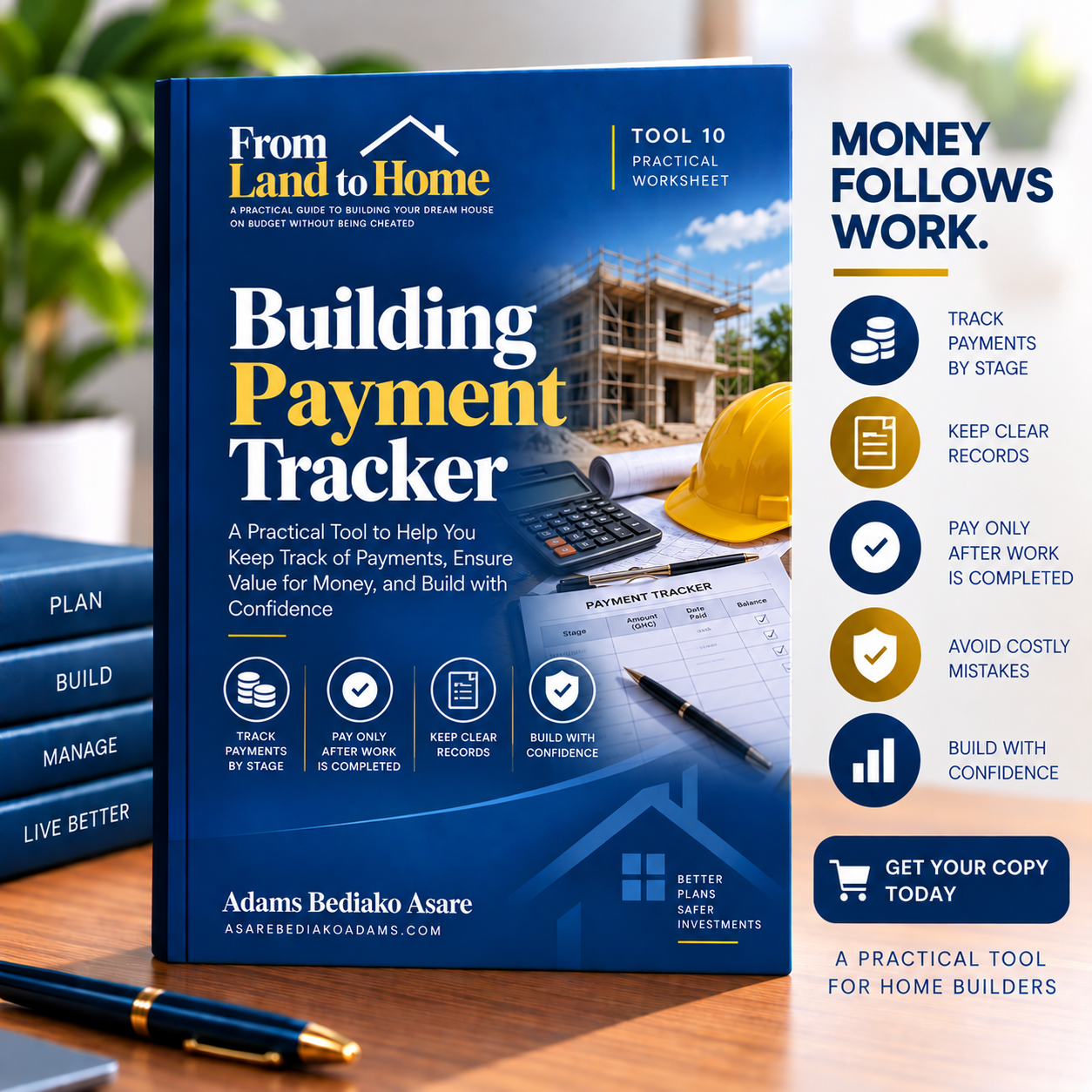
The Building Payment Tracker is a practical worksheet designed to help you control payments throughout your home-building project. It is Tool 10 in the From Land to Home companion toolkit and supports Chapters 3 and 15 of From Land to Home. The guiding principle is simple: money follows work. Pay each stage only after the work has been completed and checked, and obtain a receipt showing the amount, date and purpose of every payment.
Construction projects can become financially difficult when payments run ahead of completed work or when owners cannot clearly account for money already paid. This tracker gives you one place to record stage prices, payments, inspection status, receipts and outstanding balances.
Link Payments to Completed Work
The main section of the worksheet helps you organise payments according to the actual stages of construction.
For each stage, you can record:
- What “complete” means
- Stage price in GH₵
- Amount paid to begin
- Amount paid on completion
- Date of payment
- Payment method
- Receipt number
- Who inspected the work before payment
- Outstanding balance
This structure helps you compare money paid with work physically completed on site.
Track the Main Construction Stages
The Building Payment Tracker includes common residential construction stages such as:
- Site preparation
- Foundation
- Walls to lintel
- Roofing
- First-fix services
- Plastering, floors and ceilings
- Doors and windows
- Second-fix fittings
- Painting
- External works
- Final payment after the snag list
You can also add other stages that apply specifically to your project.
Define What “Complete” Means
One useful feature of the worksheet is the column for defining what completion means for each stage.
This helps you avoid disagreements about when a payment becomes due.
For example, rather than paying because someone says a stage is “almost finished,” you can agree in advance what work must be physically completed and inspected before the related payment is released.
Record Every Payment Properly
The tracker gives you space to record the date, method and receipt number for every payment.
The toolkit also advises that the person receiving payment should sign a receipt stating the amount, date and purpose of the payment.
Keeping this information together creates a clearer financial record of your project.
Confirm Inspection Before Payment
The worksheet includes a dedicated column for recording if the work was inspected before payment and who carried out the inspection.
This encourages you to connect payments with verified progress rather than paying automatically because a date has arrived or someone has requested money.
Compare Money Paid With Work Completed
Page 2 includes a Monthly Check that allows you to compare:
- Total paid to date
- Value of work completed
- The difference between money paid and work done
The worksheet advises you to stop and investigate before paying again if the amount already paid is running ahead of the value of completed work.
This monthly review can help you identify payment problems before they become larger financial issues.
Record the Agreed Payment Structure
At the top of the worksheet, you can record:
- Contractor
- Total contract price
- Agreed payment split
- Who has authority to approve payments
This creates a clear reference point for the payment arrangement agreed at the beginning of the project.
What This Toolkit Helps You Do
The Building Payment Tracker helps you:
- Link payments to completed construction stages
- Record the agreed contract price and payment split
- Define completion requirements
- Track deposits and completion payments
- Record dates and payment methods
- Keep receipt numbers
- Confirm inspections before releasing funds
- Monitor outstanding balances
- Compare payments with the value of work completed
- Identify situations where payments are moving ahead of construction progress
Who Is This For?
This worksheet is suitable for:
- First-time home builders
- Families managing residential construction
- Ghanaians living abroad who are funding projects at home
- Owners using staged contractor payments
- Property owners completing unfinished houses
- Clients working with contractors and artisans
- Anyone who wants clearer records of construction payments
How to Use It
Complete the contract details and agreed payment arrangement before construction payments begin.
For every stage, agree on what completion means and record the stage price. Each time money is paid, record the amount, date, payment method, receipt number and remaining balance.
Confirm that the work has been inspected before releasing completion payments.
At the end of each month, compare your total payments with the value of work actually completed. If your payments are moving ahead of the work, investigate the reason before paying again.
Product Details
Product: Building Payment Tracker
Series: From Land to Home Companion Toolkit
Tool Number: Tool 10
Related Chapters: Chapters 3 and 15
Format: Digital PDF worksheet
Length: 2 pages
Author: Adams Bediako Asare
Website: asarebediakoadams.com
The toolkit is provided for personal use and should not be sold or redistributed without permission.



Reviews
There are no reviews yet.