
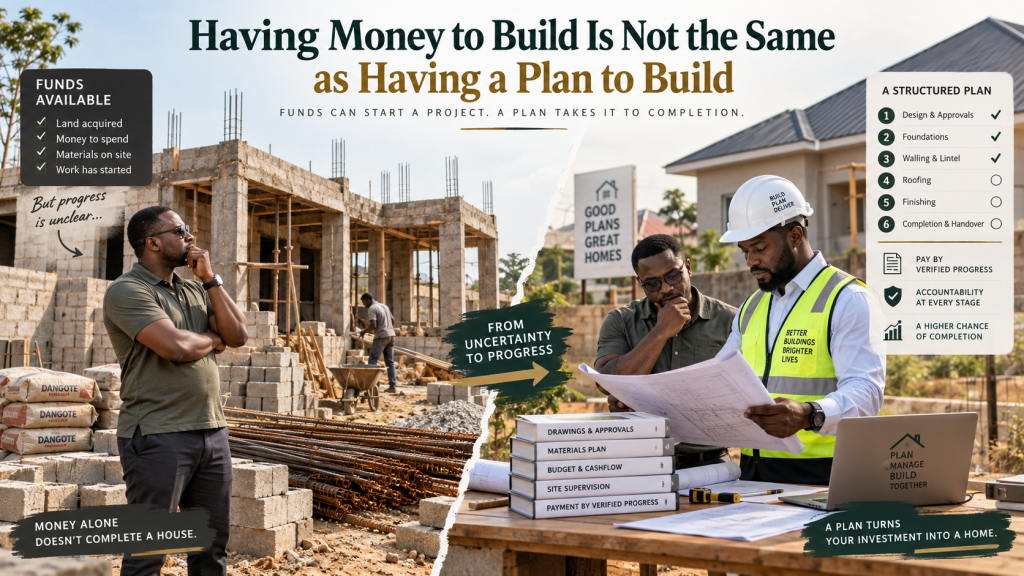
There is a particular kind of confidence that comes with money in hand. You have saved for years, or a loan has come through, or family abroad has sent something substantial home, and suddenly the plot you have been eyeing feels within reach. You call a mason. You buy a few trips of blocks. The foundation goes down, and for a while, everything feels like proof that you made the right decision.
Then life happens, the way it does.
I want to tell you about a client of mine at Abuontem Nkwanta, in the Ashanti Region. When his three-bedroom project started, he had the money to finish it. I want to be clear about that, because it matters: this was not a case of someone starting a house they could never afford. He could afford it. What he did not have was a plan.
Because his job kept him busy, he left the day-to-day running of the site to relatives, a mason and a carpenter, each paid separately as the work moved along. Materials were bought. Walls went up. But nobody was comparing what had been paid against what had actually been built. Money was leaving his hands faster than the house was rising to meet it.
By the time I was called in, the building had reached lintel level, yet he had already made payments up to the roofing stage. In cedi terms, close to GH₵300,000 had gone into that house by 2019, and we estimated that roughly GH₵200,000 more was needed to finish it. Then, right when he needed his finances steady, the bank he worked for went through a restructuring. His income became uncertain at the exact moment he was hoping to move out of rented accommodation and into his own home.
Suddenly, an unfinished building was not just an unfinished building anymore. It was the difference between paying rent indefinitely and finally having a place to call his own, and a good chunk of the money that could have closed that gap had already gone.
The lesson hiding inside this story
I have been in Ghana’s built environment for fifteen years now, as a project manager and contractor, working across communities in the Ashanti Region, Greater Accra, and the Central Region. If there is one thing that repeats itself across almost every stalled or overspent project I have seen, it is this: people plan for the money, but they do not plan for the project.
They will tell you, almost proudly, “I have GH₵150,000 saved for my house.” Ask them how that money is going to be spent, stage by stage, with what is expected to be delivered at each point, and you often get silence, or a vague answer about “starting small and seeing how it goes.”
Seeing how it goes is not a plan. It is a hope.
This is not a uniquely Ghanaian problem, but it shows up in a very Ghanaian way. Between family members who feel entitled to a say because they contributed something, artisans who are paid in bits without anyone tracking progress against payment, and the well-known culture of “building small small” as money comes in, the absence of a plan can hide inside what looks like careful, patient building. It is easy to mistake activity for progress.
What a plan actually looks like
When I was brought in to help the Abuontem Nkwanta project, the first thing we did was not lift a single block. We sat down and built a proper plan for what remained: the work broken into stages, with a clear price attached to each one. The owner would pay 70 percent of a stage’s cost to begin it, and the balance once it was satisfactorily completed. He also committed to visiting the site at the start, middle, and end of every stage, not to supervise the technical work himself, but to see with his own eyes that what he was paying for was actually happening.
That single shift, from “give the contractor money and hope” to “pay for verified progress”, changed everything. Within six months, the house was completed, and he was able to move in.
Nothing about the materials changed. The blocks, the cement, the steel, all of it was the same as before. What changed was that someone now knew, at every stage, what had been paid for and what had actually been built.
Borrowing a principle from governance
I like to think about this in terms that go beyond construction. The Chartered Institute of Leadership and Governance (CILG), Ghana Chapter, has spoken often about building institutions on accountability rather than good intentions alone. At one of its induction ceremonies, reported by the Ghana News Agency, the institute’s Country Director told newly inducted members that their shared vision was to “inspire, govern with accountability, and lead with integrity.”
That phrase, govern with accountability, is exactly what was missing from that Abuontem Nkwanta project in its early stage, and it is exactly what a good building plan gives you. You are, in a very real sense, governing a small institution for a season: money coming in, work going out, decisions being made on your behalf by people you may not see every day. A house project without a plan is a project without governance. It will drift, no matter how much money sits behind it.
What this means for you, right now
If you are sitting on savings, a loan approval, or money from relatives abroad, and you are eager to start, pause for a moment and ask yourself honestly:
Do I know exactly what each stage of this build should cost? Do I know what “complete” looks like at each stage, in enough detail that someone else could confirm it for me? Have I agreed, in writing, when payments are released and against what proof? Is there someone, even if it is me on a Saturday morning, who will physically check progress before more money goes out?
If the answer to most of those is no, you do not yet have a building plan. You have a building budget, and those are not the same thing.
Money can disappear into a half-built house faster than most people think possible, not because anyone stole it, but because nobody was watching where it went stage by stage. A plan is what stands between your savings and that quiet, slow leak.
Build the plan first. The house will follow.
This post draws on stories and lessons from my book, From Land to Home: How to Finish Your House on Budget Without Being Cheated. A free companion toolkit, including a Building Payment Tracker to help you pay by stage and not by hope, is available at www.asarebediakoadams.com.