
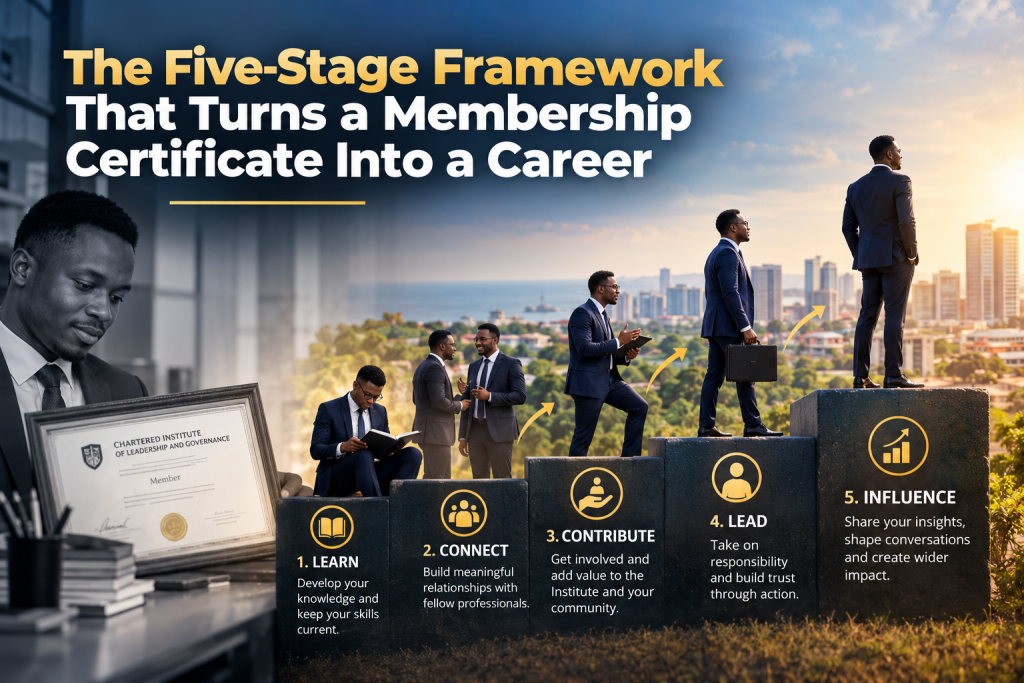
Yaw Mensah still remembers the exact date he was inducted into the Chartered Institute of Leadership and Governance. It was a Saturday morning in Accra, the hall was full, and he left with a certificate, a lapel pin, and a genuine sense that something important had just happened.
Three years later, he was still exactly where he started. Same job title in Takoradi. Same routine. The CILG certificate sat framed on his office wall, admired by clients who visited, unused by the man who earned it.
Then something shifted, not all at once, but in a series of small steps that, looking back, followed a pattern he could not have named at the time. Today, colleagues describe Yaw as one of the more visible young leaders in his field. He did not get there by accident. He got there by moving through five stages, in roughly this order, the same five stages that show up again and again in the careers of professionals who actually build something out of their membership rather than simply holding onto it.
Stage One: Learn
Yaw’s first real shift did not come from a promotion or a new job. It came from a decision to stop treating his CILG membership as something he had already finished.
He had assumed, like most newly qualified professionals do, that the certificate marked the end of the learning. It does not. It marks the beginning of a different kind of learning, the ongoing kind, the kind that keeps a professional’s competence current rather than merely credentialed.
So Yaw started attending CILG’s continuing development sessions properly, not as a box to tick for his annual requirement, but as a genuine habit. He read the materials. He asked questions in the sessions instead of sitting quietly at the back. Nothing about this looked impressive from the outside. It was simply the foundation everything else would eventually be built on.
Stage Two: Connect
The second shift happened almost by accident, at a CILG regional event in Kumasi that Yaw very nearly did not attend.
He went anyway, mostly out of a sense of obligation, and ended up in a conversation with two other members over lunch that lasted far longer than either of them expected. Nothing was transacted in that conversation. Nobody asked anybody for anything. They simply talked, the way professionals do when they are not trying to extract value from each other.
That relationship, built for no immediate reason at all, became one of the most useful of Yaw’s career two years later. This is the part most networking advice gets wrong. It tells professionals to build relationships when they need something. The professionals who actually benefit build them years before they need anything, simply by showing up consistently to the room.
Stage Three: Contribute
For a long time, Yaw assumed that volunteering for anything at CILG was reserved for members far more senior than himself. Then a chapter coordinator, short on hands ahead of a member engagement event in Cape Coast, asked if he could help with registration for a single afternoon.
It was a small, unglamorous task. Nobody remembers who managed the registration desk at a conference. But it put Yaw in a room with committee members he would otherwise never have spoken to, and it planted the idea, quietly, that contributing to the Institute was something he was actually allowed to do.
He said yes to a slightly bigger request the following year. Then a bigger one after that. None of it felt significant in the moment. Together, it built the track record that made the next stage possible at all.
Stage Four: Lead
By the time a working group needed a coordinator, Yaw was an obvious choice, not because anyone had planned it that way, but because three years of small, consistent contribution had made him a known and trusted name within his chapter.
Leading that working group taught him something he had never learned in his actual job. Nobody on that team reported to him. Nobody had to show up to the meetings he called. The only thing that made people follow his lead was trust, earned through consistency, not authority handed down from above.
He carried that lesson straight back into his workplace in Takoradi, where his manager began to notice a version of him that handled ambiguity and got people moving without needing to raise his voice or his title.
Stage Five: Influence
The final stage is the one Yaw never set out to reach, and he says so plainly whenever anyone asks him about it now.
It arrived gradually, through a chapter presentation that went further than expected, a technical article that a CILG newsletter picked up, a conversation at a governance forum in Accra that led to an invitation to speak the following year. None of it was engineered. All of it was built on the same competence, relationships, and contribution that came before it.
Today, when a business publication wants a Ghanaian voice on leadership and governance in the private sector, Yaw’s name comes up more often than it used to. He is careful never to credit talent for this. He credits five ordinary decisions, repeated for long enough that they stopped feeling ordinary at all.
The Framework, in Plain Terms
Learn. Connect. Contribute. Lead. Influence.
None of these stages requires exceptional talent, and none of them can be skipped without leaving a gap that eventually shows. A professional who learns without ever connecting stays technically excellent and professionally invisible. One who connects without ever contributing builds a pleasant network that never quite turns into anything. The order matters, and so does the patience to move through it honestly, one ordinary decision at a time.
Yaw’s certificate still hangs on his office wall in Takoradi. It means something different to him now than it did on that Saturday morning in Accra. Not an ending. A starting point he almost walked past.
This post draws on the framework at the heart of Maximising Your Professional Membership*, available now at* www.asarebediakoadams.com, where you can also read the introduction for free and download a set of personal development worksheets.