
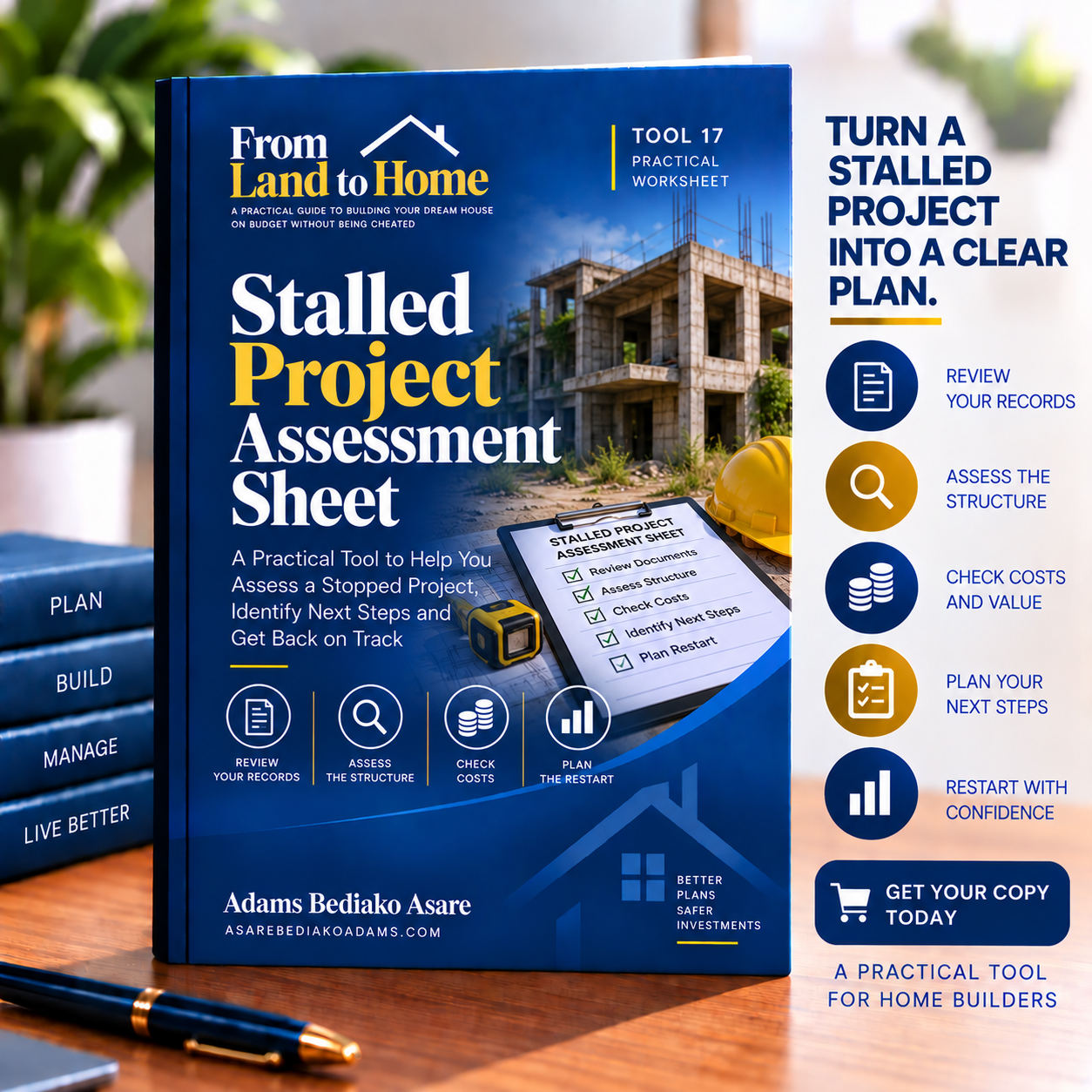
The Stalled Project Assessment Sheet is a practical worksheet designed to help you assess a building project that has stopped before committing any additional money. It is Tool 17 in the From Land to Home companion toolkit and supports Chapter 22 of From Land to Home. The worksheet advises you to take stock first, appoint an engineer and quantity surveyor, assess the condition and value of the work already completed, and avoid rushing to conclusions.
When a building project stalls, the immediate reaction may be to send more money, replace the contractor or continue work quickly. This assessment sheet gives you a structured process for reviewing what has happened, what remains usable, how much has already been spent and what it may cost to complete the project.
Identify Why the Project Stopped
The worksheet begins by asking you to state, in one sentence, why the project stopped.
This helps you separate the main cause from the many symptoms that may have appeared around the project.
The reason could relate to funding, contractor performance, disputes, material shortages, poor planning or another issue. The worksheet provides space for you to record the cause clearly before deciding what to do next.
Pause Before Spending More
One of the first sections encourages you to pause further commitments while the project is being assessed.
You can confirm that:
- You have stopped sending new money
- You have not signed anything new
- You have avoided making accusations before the facts are clear
- Someone is watching the site
- Any damage or theft is being recorded
This creates time to assess the situation before taking another financial or contractual step.
Gather and Review Your Documents
The Stalled Project Assessment Sheet helps you establish which project records are available and which may need to be reconstructed.
The document checklist includes:
- Land documents
- Permit, drawings and specifications
- Contract, quotations or written agreements
- Payment records
- Bank and mobile money records
- Records of materials purchased and delivered
- Photographs and messages showing what was completed and when
This gives you a clearer documentary basis for reviewing the project.
Assess the Condition of the Structure
The worksheet includes a dedicated section for an engineer to assess the physical condition of the building.
The assessment can cover:
- Foundation
- Walls and blockwork
- Columns, beams and lintels
- Exposed reinforcement steel
- Roof
- Other structural elements
For each item, the engineer can record findings, recommend if it should be protected, repaired or replaced, and record the estimated cost.
This is particularly useful when a project has remained exposed to weather for an extended period.
Compare Money Paid With Work Built
A major part of the assessment is comparing how much money has been paid with the value of work physically completed.
The worksheet provides columns for:
- Stage or item
- Amount paid
- Value of work completed as assessed by the quantity surveyor
- Difference
- Explanation
The sheet also notes that differences may have explanations, such as materials already on site or money paid in advance, and advises taking professional advice before deciding what any difference means.
Estimate the Cost to Complete
The quantity surveyor can also use the worksheet to estimate the cost of completing the project.
The assessment can include:
- Repairs required because of exposure
- Remaining structural work
- Services
- Finishing
- External works
- Professional fees and approvals
- Contingency
This gives you a more realistic picture of how much additional funding may be required before deciding if and how to restart.
Decide Who Will Continue the Work
Once the project has been assessed, the worksheet helps you consider three possible routes:
- Continue with the same contractor
- Appoint a new contractor
- Change the construction route
If you change contractor or route, the worksheet also reminds you to record what has already been completed, measure the work, settle what is owed, document the condition of the project and hand over site information and materials properly.
Prepare a Restart Plan
The Stalled Project Assessment Sheet includes a restart planning section where you can record:
- Construction stage
- Price
- What “complete” means
- Payment split
- Who will check the work
This helps create clearer conditions before construction resumes.
Identify the Funding Needed
The final section gives you space to record the sources, amounts and expected dates of funding needed to restart the project. It links with the Funding and Phasing Planner in Tool 5.
What This Toolkit Helps You Do
The Stalled Project Assessment Sheet helps you:
- Identify why a project stopped
- Pause additional spending while facts are gathered
- Review missing and available project documents
- Assess the structural condition
- Compare money paid with the value of work completed
- Estimate repair and completion costs
- Decide if the current contractor should continue
- Plan for a new contractor or different build route
- Prepare a structured restart plan
- Identify the funding required to continue
Who Is This For?
This worksheet is suitable for:
- Owners of unfinished or abandoned houses
- Families whose construction has stopped
- Ghanaians living abroad managing stalled projects at home
- Clients considering replacing a contractor
- Owners who need to assess work completed before spending more
- Property owners taking over a poorly documented building project
- Anyone preparing to restart residential construction
How to Use It
Complete the worksheet before sending additional money or recommencing construction.
Begin by recording why the project stopped and gathering the available project documents. Ask an engineer to assess the physical structure and a quantity surveyor to value the work completed and estimate what remains.
Compare what has been paid with what has actually been built. Then decide who should continue the project and prepare a written restart plan before new work begins.
Product Details
Product: Stalled Project Assessment Sheet
Series: From Land to Home Companion Toolkit
Tool Number: Tool 17
Related Chapter: Chapter 22
Format: Digital PDF worksheet
Length: 3 pages
Author: Adams Bediako Asare
Website: asarebediakoadams.com
The toolkit is provided for personal use and should not be sold or redistributed without permission.



Reviews
There are no reviews yet.