
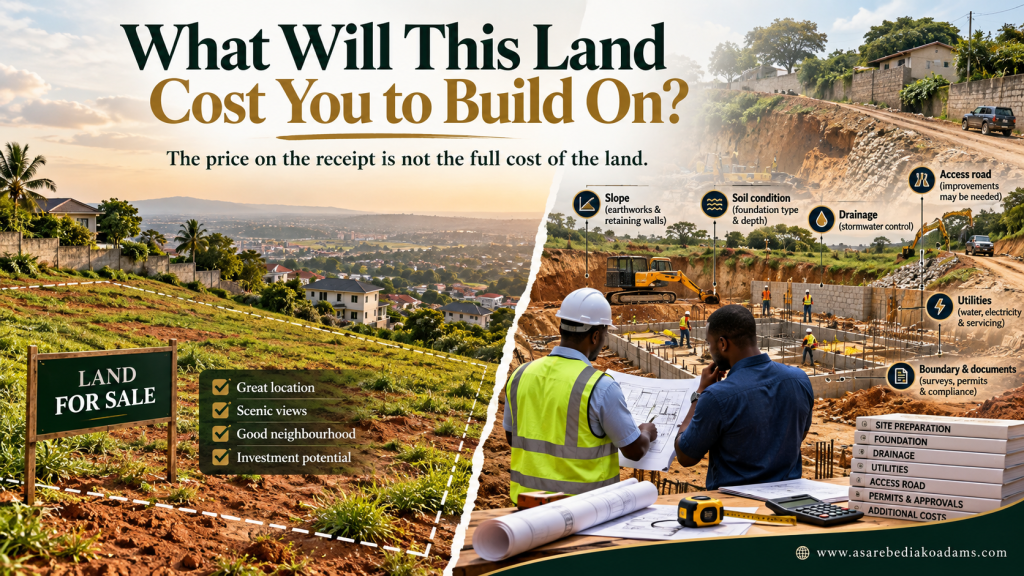
There are two prices on every piece of land in Ghana. One is written on the receipt. The other one shows up slowly, over the months after you have already started building, and by then it is far too late to negotiate.
I have been a project manager and contractor for fifteen years now, working across the Ashanti Region, Greater Accra, and the Central Region. If there is one question I wish every prospective landowner asked before signing anything, it would be this one: not “how much does this land cost,” but “what will this land cost me to build on.”
They sound similar. They are not the same question at all.
The plot that looked perfect
A client of mine bought a plot in the Ashanti Region some years ago. She liked the location. The price fit her budget. By the time I became involved, the land had already been paid for in full.
On the surface, nothing was wrong. But the plot had a slope, and that slope had not looked serious when she first walked it and fell in love with the view. It is one of those things that is easy to miss when you are imagining where the gate will go and where the children will play, rather than thinking about how water drains, or how deep the foundation will need to go on one side compared to the other.
Once construction began and we had to deal with the levels properly, the cost of the substructure alone increased by roughly 30 percent above what had originally been planned. That is not a small adjustment. For someone building on a fixed budget, that extra 30 percent did not fall from the sky. It came straight out of money that had been set aside for finishing, for the tiles, the doors, the paint, the things that actually make a house feel complete.
The price on her receipt never changed. The real cost of that land kept growing long after the sale was done.
The hidden price tags nobody talks about
When most people evaluate land, they look at three things: the price, the location, and whether the documents look official. I understand why. Those are the things you can see and compare easily.
But the real cost of land hides in details that only reveal themselves once construction begins, or sometimes once you have been living in the house for a year or two.
The slope and soil. A gentle slope might look charming, but it can mean extra excavation, retaining walls, or a deeper foundation on one side. Different soil types across the same community can also mean very different foundation requirements, something only a proper site assessment, not a casual walk through, will tell you.
Access for construction. Can a tipper truck actually reach the plot to deliver blocks, sand, and cement? I have seen sites where materials had to be head carried for a stretch because the access road could not take a vehicle, and that labour cost adds up quickly over the life of a project.
Drainage. Where does water go when it rains heavily? Land that sits lower than its surroundings, or that has no natural drainage path, can mean recurring problems long after the house is built, the kind that erode foundations slowly over years.
Utility connections. How far is the plot from the nearest electricity pole or water main? Extending these services across even a modest distance adds a cost that rarely appears in anyone’s early budget, because nobody thought to ask the question before buying.
Documentation and boundary disputes. This is the one people fear most, and rightly so, but it belongs on this list too. A plot with unresolved family or chieftaincy claims can cost you in legal fees, delays, and sometimes outright loss, long after the purchase price has already been spent.
None of these show up when you are standing on the land admiring the view. All of them show up later, usually at the worst possible moment, when your budget is already stretched and your patience is already thin.
Building on a strong foundation, in more ways than one
I think often about something said at a past induction ceremony of the Chartered Institute of Leadership and Governance, Ghana Chapter, held in Kumasi. The institute’s Country Director, Dr Asare Bediako Adams, spoke about the organisation’s commitment to “building a strong foundation of leadership rooted in integrity.”
It is a phrase meant for leadership, but it translates almost perfectly into land and construction. A foundation, whether in leadership or in a house, is not the part people admire. Nobody takes photographs of a foundation for their family WhatsApp group. But everything you build afterward depends entirely on how honestly that foundation was assessed before the first cedi changed hands.
Buying land on price and appearance alone is like appointing a leader on charisma alone, without checking their track record. It might work out. But if it does, that is luck, not planning.
Asking the right question before you pay
Before you commit to any plot, bring in someone who understands construction, not just a land agent, but an engineer or an experienced contractor who can walk the site with you and tell you honestly what it will take to build there. Ask about the slope. Ask about the soil. Ask about access, drainage, and how far the nearest utilities actually are. Get the documentation properly checked by a lawyer, not just glanced at.
Then ask for a rough estimate of what these factors could add to your construction budget. It will not be exact, nothing at this stage ever is, but it will be far more honest than the number printed on your receipt.
The price of land tells you what you are paying today. The cost of land tells you what you will actually spend before you ever move in. Learn to ask about the second one, and you will save yourself far more than you think.
This post draws on stories and lessons from my book, From Land to Home: How to Finish Your House on Budget Without Being Cheated. A free companion toolkit, including a Land Inspection Checklist to help you spot these hidden costs before you buy, is available at www.asarebediakoadams.com.