
In many Ghanaian workplaces, seniority carries enormous weight, and for good reason. We respect experience. We lower our voices when the longest-serving person in the room begins to speak. “Ten years in the service” is said with a certain pride, and often it is well deserved.
But there is a quiet question that very few of us ask out loud: does ten years of experience mean ten years of growth, or one year of experience repeated ten times?
A Tale of Two Teachers
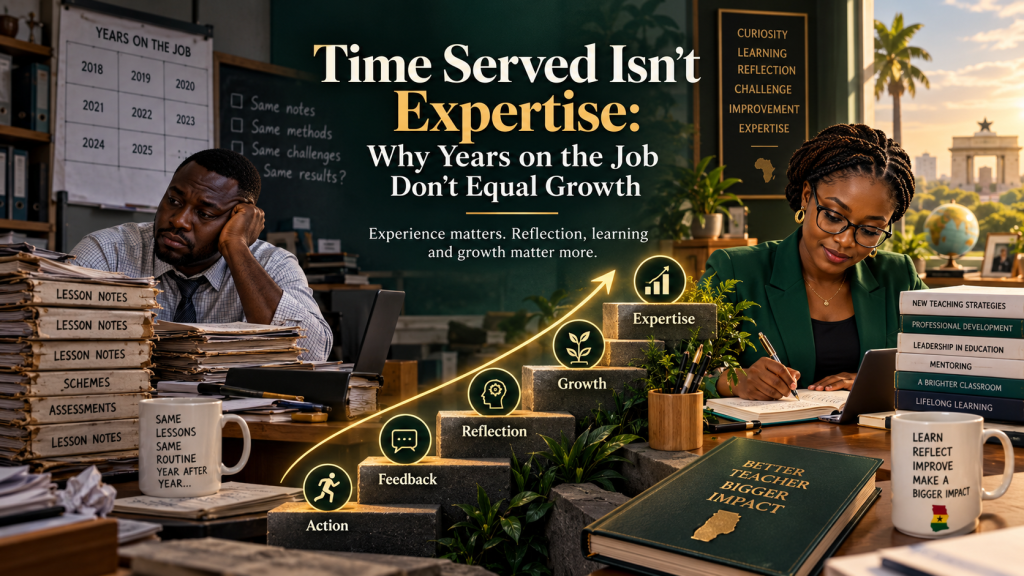
Consider two teachers who both started at public secondary schools in the Ashanti Region in the same year. I will call them Mr. Osei and Madam Efua. They are composites of many professionals I have met, but I suspect you will recognise them.
Mr. Osei is dependable. He arrives early, marks on time, and prepares his lessons from the same well-worn notes he built in his first two years. Those notes worked then, so he sees no reason to change them. Every September, he delivers the same lessons, in the same order, with the same examples. He has fifteen years of service.
Madam Efua started the same way. But somewhere in her third year, a student asked a question she could not answer. Instead of brushing it off, she went home and worked at it until she could. After a disappointing WASSCE result in one of her classes, she did not simply blame the students. She sat with the past papers and asked what she had actually failed to teach. Each year she changed something, and she kept a small notebook of what worked and what did not.
Fifteen years later, both have the same number of years in service. But Mr. Osei has effectively had one year of experience fifteen times. Madam Efua has had fifteen.
Experience Only Counts If You Learn From It
This is the part we rarely say plainly: time in a role is not the same as expertise.
Genuine expertise comes from tested experience. You make a judgement, you see what happens, and you adjust the way you think the next time. That loop of action, feedback, and refinement is what slowly builds real skill. Without it, years simply pass.
Think of the mechanic in Suame Magazine who can diagnose an engine problem just by listening to it. He did not get that ability by clocking in for twenty years. He got it by opening up thousands of engines, being wrong often enough to be humbled, and paying attention to why. The mechanic next to him, with the same twenty years, still reaches for the same three guesses.
Same shop. Same years. Very different expertise.
The Trap Gets Worse as You Rise
Here is the part that should make all of us a little uncomfortable. This problem often gets worse, not better, as we become more senior.
Early in a career, everything is new. Every case teaches you something. But as you rise, your work increasingly involves applying what you already know, rather than learning something fresh. You are asked for your opinion more and challenged less. The number of genuinely new, difficult, learning-rich situations you face can actually shrink, even as your title grows.
The result is a risky gap: a reputation that keeps growing while the expertise underneath it quietly stands still. You may know a senior manager like this, or a long-serving official whose confidence is built entirely on knowledge that was current in 2008. Their juniors may sense it, but are too polite to say so.
When a new regulation is announced, or a new technology arrives, or a new way of doing things begins to spread, that gap becomes visible very quickly. This is why a field’s most experienced voices are not always its most current ones.
So How Do You Keep Growing?
The good news is that none of this is fixed. Growth is a habit, and habits can be built at any stage. A few simple practices go a long way.
Seek out the harder cases. It is tempting to give the difficult, messy problems to someone else, and keep the comfortable work for yourself. Do the opposite. The difficult case is where your judgement is actually tested, and tested judgement is the whole point.
Keep a simple record. Madam Efua’s little notebook was not glamorous, but it was powerful. A few lines each week on what surprised you, what you would do differently, and what pattern you are noticing across cases becomes a record of your own learning. It also becomes raw material for the day you want to write, teach, or speak about what you know.
Look hardest at your failures. It is human to move quickly past what went wrong. But the failures usually hold the most useful information. Professionals who never examine their mistakes tend to repeat them in slightly different forms for decades.
Stay curious about your own field. Read what is new. Ask the younger colleague what they are learning. Sit in on a session at a professional association meeting, whether in Accra, Kumasi, or Tamale. Expertise is not a certificate earned once. It is a standard that has to be maintained.
Let people challenge you. If nobody around you ever disagrees with you, that is not always a sign that you are right. Sometimes it means you have stopped being questioned. Invite the challenge on purpose.
A Question Worth Sitting With
The next time someone tells you how many years they have in a role, or the next time you say it yourself, try asking a different question: what have those years actually taught?
Years on the job are a gift. They give you the chance to grow. But they are only the chance. Whether that chance turns into real expertise depends entirely on what you do with the time.
Mr. Osei and Madam Efua walked into the same staff room on the same first morning. Fifteen years later, one has a long record of service. The other has a long record of growth. Both are respectable. Only one is truly an expert.
This idea is explored in more depth in my book, From Expertise to Influence: How Professionals Become Trusted Voices in Their Fields, available now at www.asarebediakoadams.com.