
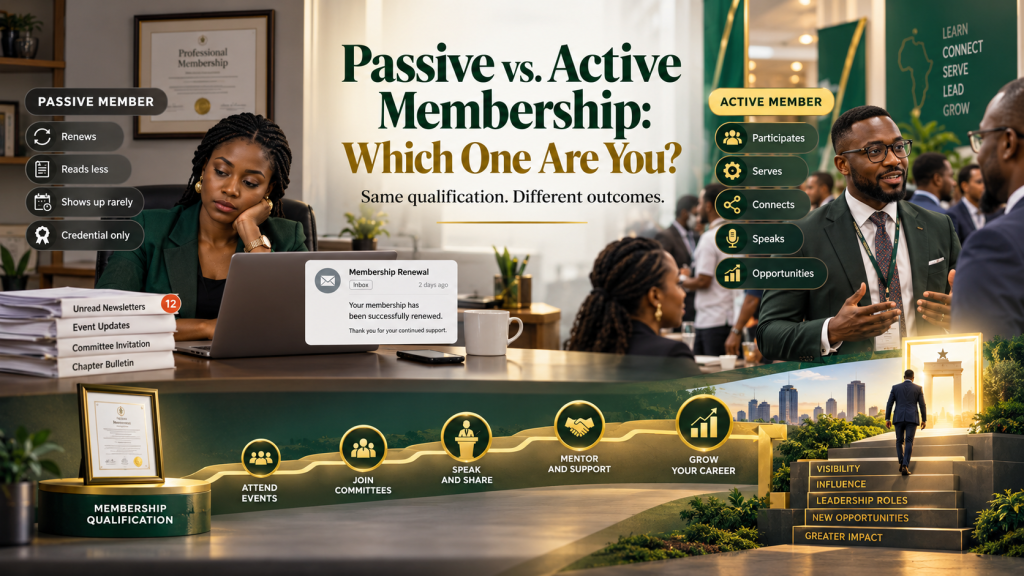
Nana Yeboah renewed her membership with the Chartered Institute of Leadership and Governance for the ninth year running last month. She did it the way she always does: an email reminder lands in her inbox, she transfers the fee from her Barclays account, and a receipt arrives a few minutes later. By lunchtime she has forgotten it happened.
Ask her what the Institute has done for her career this past year and she will pause for a while before admitting she is not entirely sure. She has never attended a chapter meeting in Accra. She could not name the current president of her branch if her job depended on it. The quarterly newsletter sits in a folder she created specifically so it would stop cluttering her main inbox, unread.
This is not laziness. Nana is good at her job, respected by her colleagues at the bank where she works, and genuinely proud of her professional designation. She simply joined the category of member that most professional bodies quietly depend on to keep the lights on: the passive member. Fees paid, presence absent.
A few floors down, in the same building, works a man named Kojo Danso. He joined CILG around the same time as Nana, sat the same qualifying exams, and carries the same post-nominal letters after his name. But Kojo’s relationship with his professional body looks nothing like hers.
He sits on his chapter’s events committee. He showed up, uninvited and a little nervous, to his first Annual General Meeting six years ago, and has not missed one since. When a vacancy opened on a regional working group last year, three people recommended him before he had even applied. Last October, he was one of two Ghanaian panellists invited to speak at a governance conference in Takoradi, an invitation that traces back, in a fairly straight line, to a presentation he gave at a small chapter event two years earlier that almost nobody famous attended.
Same qualification. Same certificate. Same designation after their names. Completely different careers unfolding, quietly, year after year, inside the same organisation.
This is the real divide inside every professional body, and it rarely gets named directly: passive membership versus active membership. It has very little to do with talent, and almost everything to do with a pattern of small decisions repeated often enough that they stop looking like decisions at all.
What passive membership actually looks like
Passive membership is not usually a conscious choice. Nobody wakes up and decides to disengage from their professional body. It happens the way most quiet habits happen: one skipped meeting becomes two, one unread newsletter becomes a dozen, and eventually the whole relationship settles into something that exists mainly on a renewal invoice.
The passive member still gets real value from membership. There is a credential that opens certain doors, a baseline of credibility that comes simply from holding the designation, perhaps occasional access to a resource or a discount. But the deeper value, the kind that actually changes a career, goes almost entirely untouched. The committee seats are filled by someone else. The speaking opportunities go to a name that keeps appearing at events. The mentorship, the referrals, the quiet recommendations that happen when three colleagues are discussing who should get a particular opportunity, these all accrue to people the organisation actually knows.
What active membership actually looks like
Active membership, by contrast, is built almost entirely out of unglamorous, repeatable actions. It is rarely one dramatic gesture. It is showing up to the meeting that feels optional. It is reading the newsletter closely enough to know what the organisation is actually working on. It is saying yes to a small task, running a registration desk, drafting a short report, helping organise a regional event, long before there is any obvious reward attached to saying yes.
Kojo did not become a recognised voice in governance circles because CILG handed him a platform. He built a track record of reliability in small, visible ways, and the organisation responded to that pattern by trusting him with larger ones. Active membership compounds. Each small contribution becomes evidence for the next opportunity.
Why the gap rarely closes on its own
Here is the uncomfortable part. The longer someone stays passive, the harder active membership becomes to start, not because the door closes, but because the habit of staying away gets stronger with every renewal cycle. A member five years into passive membership has to overcome five years of not knowing anyone in the room, not understanding the organisation’s current priorities, and feeling, often wrongly, that everyone else already belongs there in a way they do not.
The good news, and it is worth saying plainly, is that this gap closes faster than most passive members expect. Professional bodies are usually hungry for members willing to contribute. A single email to a chapter coordinator, a first appearance at one meeting, a willingness to take on one small task nobody else wanted, these are often all it takes to begin moving from one category into the other.
Which one are you?
If you are reading this and recognising Nana more than Kojo, that recognition is not a verdict on your career. It is simply useful information. The subscription renewal that lands in your inbox next time is as good a moment as any to ask yourself one honest question before paying it without thinking: are you using this membership, or just holding onto it?
The certificate on the wall looks identical either way. What happens to the career behind it does not.