
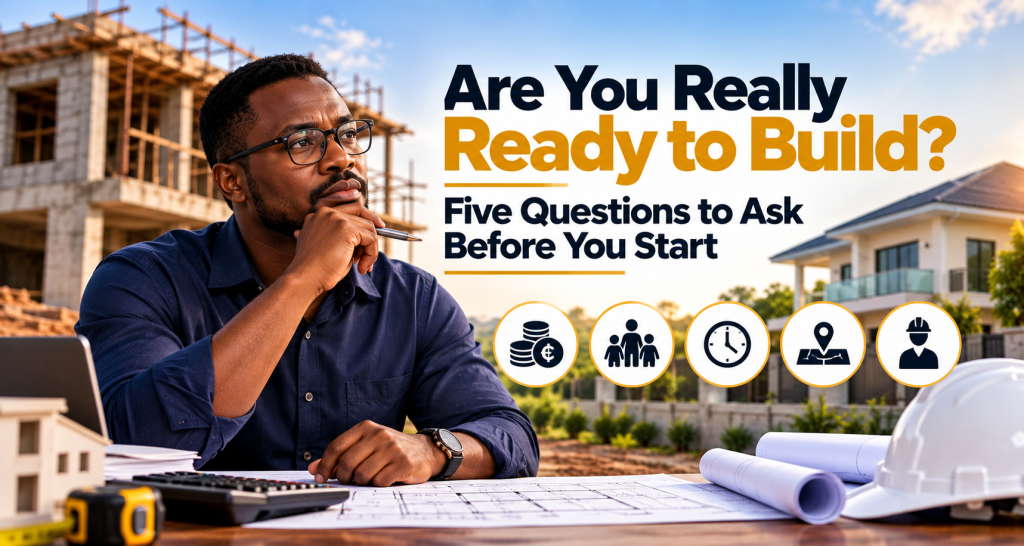
There is a particular excitement that comes with deciding to build. You have found the land, or you are close to it. You have started saving seriously, or a relative abroad has promised to support you. In your mind, you can already see the finished house: the gate, the compound, the veranda where you will sit in the evenings.
That picture is powerful, and it is usually the reason the whole project begins. But a picture is not a plan, and excitement is not readiness.
I have worked as a project manager and building contractor in Ghana for fifteen years, across communities in the Ashanti Region, Greater Accra, and the Central Region. In that time, I have watched people start building at the right moment, and I have watched others start too early, carried mostly by enthusiasm. The second group almost always pays for it later, in delays, disputes, or a half-finished house that sits there for years as a quiet source of stress.
Before you break ground, or even before you pay for land, ask yourself these five questions honestly. Not the answers you think will impress your family or your pastor. The real ones.
1. Can I count on the money for the whole house, not just the start?
This is the question most people get wrong. They confuse “I have money to start” with “I have money to finish.”
I always tell clients to separate the money they actually have from the money they hope to have. If your plan depends on a promotion that has not happened yet, a plot of land you intend to sell, or a relative abroad who has said “don’t worry, I will support you” without a specific figure, that is hope, not money.
Ask yourself what happens to the project if your income drops for six months. Could the house be built in stages, at a point where you can safely pause without the structure suffering? If you cannot answer that clearly, you are not ready to start, you are ready to plan.
2. Do the people who will live in this house agree on what is being built?
Many building disputes in Ghana do not happen between the homeowner and the contractor. They happen inside the family, quietly, and they surface halfway through construction when it is expensive to change course.
A husband wants four bedrooms, his wife wants a boys’ quarters for visiting family, his mother expects a room reserved for her when she visits from the village, and nobody has actually sat down to agree on the size, the layout, or the budget together. Settling these disagreements before construction begins costs you a conversation. Settling them after the foundation is laid can cost you a wall.
If relatives are contributing financially, this question becomes even more important. Agree early on who has a say in decisions and who is simply being kept informed. Both are valid roles, but confusing them causes real friction later.
3. Do I have the time this project actually needs?
Building a house is not something you set in motion and forget about until it is finished. It needs attention: site visits, decisions on materials, approving changes, being reachable when your supervisor calls with a question.
If you work long hours, travel frequently, or are based outside the region or country, be honest about how much time you can genuinely give. This does not mean you should not build. It means you need someone you trust to represent you on site, with clearly defined authority, so the project does not stall every time you are unavailable.
4. Do I already have land, and is it truly settled?
If you have not yet secured land, that is a decision on its own, with its own risks around ownership, boundaries, and documentation. It should never be treated as a small detail you will “sort out along the way.”
If you already have land, ask yourself honestly whether the paperwork is fully in order, whether the boundaries are undisputed, and whether there are no lingering family or community claims on it. Land disputes in Ghana have a way of resurfacing at the worst possible moment, often right after you have invested significant money into a structure.
5. Who will actually manage this project, day to day?
This is the question people skip most often, because it feels like a detail to figure out later. It is not a detail. It is the difference between a project that runs and a project that drifts.
Will it be you, personally, walking the site every week? A professional you have hired and trust? A relative with construction experience? If your honest answer is “I will work it out once we start,” that answer itself tells you something important: you are not ready yet.
This matters even more if you are living abroad and building at home. Distance changes everything about how a project is managed, and pretending it does not is one of the most common and costly assumptions I see.
The value of “not yet”
None of this means you should abandon your dream. It means giving yourself permission to say “not yet” without treating it as failure.
I think often about something the Chartered Institute of Leadership and Governance, Ghana Chapter, has said about its own members. At one induction ceremony in Kumasi, reported by the Ghana News Agency, the institute’s Country Director reminded newly inducted leaders that stepping into a role of responsibility “is a pledge to embody the highest standards of governance and ethical practice.” That pledge only means something if the person taking it has honestly assessed whether they are ready to carry it.
Building a house is a similar kind of pledge, mostly to yourself and to the people who will live in that house with you. Someone who takes six months to settle their finances, agree with their family, and understand the process ahead of them will almost always build better and with far less stress than someone who starts because the excitement felt too strong to wait.
You are ready to move forward when you can answer, honestly and in a few clear sentences: why you are building, what kind of house you actually need, how much money you can truly count on, where that money is coming from, and who will be in charge when you are not there to check.
You do not need every answer to be perfect. You need every answer to be honest.
This post draws on stories and lessons from my book, From Land to Home: How to Finish Your House on Budget Without Being Cheated. A free companion toolkit, including a Dream House Needs Assessment worksheet to help you and your family agree before you begin, is available at www.asarebediakoadams.com.